Court Marriage in Karachi | A Complete Legal and Procedural Guide
Court Marriage in Karachi: A Complete Legal and Procedural Guide
Marriage in Pakistan is a significant social and legal contract. While traditional ceremonies involving large gatherings are the cultural norm, court marriage has emerged as a practical, legally robust, and increasingly common alternative. In a bustling metropolis like Karachi, the procedure is streamlined, yet it remains shrouded in misconceptions.
This guide provides an exhaustive look at the entire process of court marriage in Karachi, covering the legal framework, required documentation, step-by-step procedures, and the post-marriage legal protections available to couples.
1. Understanding the Concept of Court Marriage in Pakistan
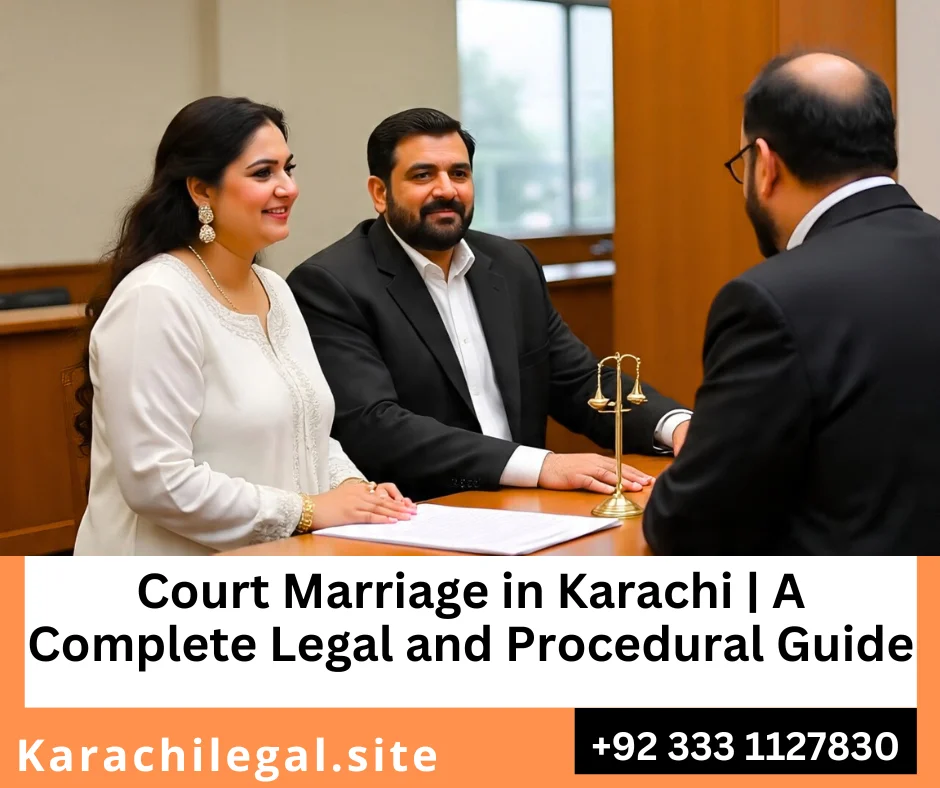
In the Pakistani legal context, a “court marriage” is a union solemnized with the help of a lawyer and a Nikah Khawan (marriage registrar) authorized by the state, usually within the premises of a court or a lawyer’s chamber, rather than at a traditional wedding venue.
It is crucial to understand that court marriage is not a separate type of marriage; it is simply a different method of solemnizing the Nikah. It follows the same Islamic principles as a traditional wedding:
- Offer and Acceptance (Ijab-o-Qubool): The bride and groom must willingly consent to the marriage.
- Dower (Haq Meher): A mandatory gift (usually financial) from the groom to the bride.
- Witnesses: The presence of two Muslim male witnesses (or one male and two females).
The primary difference lies in the legal documentation. In a court marriage, the legal paperwork (Nikah Nama) is processed immediately and registered with the relevant Union Council to ensure the marriage is legally binding and recognized by the state.
Legal Basis
The procedure is governed by:
- The Muslim Family Laws Ordinance, 1961
- The Child Marriage Restraint Act (specifically the Sindh Child Marriage Restraint Act, 2013, which sets the age limit in Sindh).
- The West Pakistan Rules under the Muslim Family Laws Ordinance, 1961

2. Eligibility Criteria for Court Marriage in Karachi
Before proceeding, couples must ensure they meet the legal requirements specific to the province of Sindh.
Age Requirements (Sindh Province)
The laws in Sindh are distinct regarding the age of marriage compared to other provinces:
- Bride: Must be 18 years of age or older.
- Groom: Must be 18 years of age or older.
Important Note: The Sindh Child Marriage Restraint Act, 2013, strictly prohibits the marriage of anyone under 18. This is strictly enforced in Karachi courts to prevent legal complications or annulment.
Consent
Both parties must enter into the marriage of their own free will (sui juris). There must be no coercion or force. The court or the Nikah Registrar will ask the bride explicitly if she is consenting to the marriage without duress.
Marital Status
- Unmarried: If never married, no additional proof is needed other than the CNIC.
- Divorced: Must provide a divorce certificate.
- Widowed: Must provide the Death Certificate of the deceased spouse.
- Existing Marriage (For Men): If a man wishes to contract a second marriage, he must provide written permission from his first wife, as required by the Arbitration Council under the Muslim Family Laws Ordinance.
3. Required Documents
To initiate the process in Karachi, you must prepare the following documentation. Missing documents can cause delays.
For the Bride and Groom
- CNIC (Computerized National Identity Card): Original and valid copies for both parties.
- B-Form (if CNIC is unavailable): In rare cases, if a CNIC is pending, a B-Form along with a valid passport or matriculation certificate might be accepted to prove age, but the CNIC is highly preferred.
- Passport-Size Photographs: Usually 4–6 photographs of both the bride and groom.
- Affidavit of Free Will: A sworn statement (usually drafted by the lawyer) stating that the bride and groom are marrying of their own accord.
For the Witnesses
- CNIC Copies: Two witnesses are required. They must have valid CNICs.
- Note: If the couple does not have witnesses (e.g., they have eloped or are keeping it private), lawyers can often arrange for witnesses from their staff or chambers, which is legally permissible as long as they are Muslim males of sound mind.

4. The Step-by-Step Procedure
The process of court marriage in Karachi is generally completed in a single day, often taking 2 to 4 hours.
Step 1: Consultation with a Lawyer
The couple must engage a lawyer who specializes in family law. The lawyer will verify the documents, particularly the age proof (CNIC), to ensure compliance with the Sindh Child Marriage Restraint Act.
Step 2: Drafting the Affidavit
The lawyer will draft an Affidavit of Free Will (sometimes called a Free Will).
- Purpose: This document serves as legal proof that the bride is an adult (18+) and is marrying the groom without any pressure or kidnapping.
- Execution: This affidavit is signed by the bride and attested by a notary public or an oath commissioner. This is a critical defense document against any future false FIRs (First Information Reports) regarding kidnapping.
Step 3: The Nikah Ceremony
The Nikah is performed by a registered Nikah Khawan (usually arranged by the lawyer).
- Ijab-o-Qubool: The Nikah Khawan recites the Khutba-e-Nikah and asks for the consent of both parties in the presence of the two witnesses.
- Haq Meher: The amount of Haq Meher is decided and recorded. It can be Mu’ajjal (prompt/paid immediately) or Ghair Mu’ajjal (deferred).
- Signing: The bride, groom, and witnesses sign the Nikah Nama (marriage contract).
Step 4: Attestation by Magistrate (Optional but Recommended)
In some cases, the couple may appear before a Justice of Peace or a Magistrate to record their statement under Section 164 of the CrPC. This statement reinforces that the marriage was consensual and acts as strong evidence if the bride’s family files a harassment or abduction case.
Step 5: Registration of Nikah
After the ceremony, the Nikah Khawan submits the signed Nikah Nama to the relevant Union Council for registration.
- The Union Council issues the computerized NADRA Marriage Registration Certificate (MRC). This usually takes a few days to process, though the manual Nikah Nama is available immediately.


5. The Nikah Nama: Clauses to Watch
The Nikah Nama is a legal contract with various columns. When doing a court marriage, ensure the following are filled correctly:
Column No. | Description | Importance |
13-16 | Haq Meher Details | Clearly state the amount and whether it is prompt or deferred. |
18 | Right of Divorce (Talaq-e-Tafweez) | Crucial: This column asks if the husband delegates the right of divorce to the wife. If “Yes,” the wife can divorce herself legally without needing a Khula decree from a court. Lawyers sometimes cross this out by default; couples should discuss this beforehand. |
19 | Restrictions on Husband | Any special conditions (e.g., monthly allowance, preventing second marriage without permission) can be written here. |
6. Legal Protections and Safety
One of the main reasons couples in Karachi opt for court marriage is family opposition. In such scenarios, safety is paramount.
Protection Against Harassment
If the couple fears violence or harassment from family members:
- Petition to Sessions Court/High Court: The lawyer can file a petition under Section 22-A/B CrPC or a constitutional petition in the Sindh High Court seeking protection for the couple.
- Restraining Orders: The court can issue orders to the police to ensure the couple is not harassed and that no false FIRs (such as kidnapping charges under Section 365-B PPC) are registered against the groom.
Dealing with False FIRs
It is common for disapproving families to file a kidnapping case (Zina/Abduction) against the husband.
- The Affidavit of Free Will and the Nikah Nama are the primary defense documents.
- If the bride records a statement before a magistrate confirming she married of her own free will, the courts invariably quash the kidnapping FIRs, as an adult woman in Pakistan has the full legal right to choose her spouse.
7. Court Marriage Fees in Karachi
The cost of a court marriage in Karachi varies depending on the lawyer and the services required. It is generally an affordable process.
- Professional Fee: Includes the lawyer’s time, drafting of affidavits, and court appearances.
- Nikah Khawan Fee: The honorarium for the person solemnizing the marriage.
- Union Council Registration Fee: Official government fees for registering the marriage.
- Affidavit/Notary Fees: Costs for stamp paper and attestation.
Estimated Range: Packages can range from PKR 15,000 to PKR 50,000, depending on the reputation of the law firm and whether expedited NADRA registration is included.
8. Post-Marriage Procedures
Once the Nikah is signed, there are a few administrative tasks the couple should complete to regularize their status:
- CNIC Update: The wife should apply to NADRA to update her marital status and change her surname (if she chooses) to her husband’s name. This requires a computerized marriage certificate.
- NADRA Marriage Certificate: Ensure you collect the computerized certificate from the Union Council. This is the only document accepted for visa applications and international travel.
9. Myths vs. Reality
Myth: Court marriage is un-Islamic.
Reality: Court marriage fulfills all Islamic requirements (Proposal, Acceptance, Witnesses, Meher). It is fully Sharia-compliant.
Myth: Court marriage is not valid for visas.
Reality: The computerized Marriage Registration Certificate (MRC) issued after a court marriage is the standard document required for all visa and immigration processes.
Myth: The police can arrest the couple.
Reality: The police have no authority to arrest a couple who can produce a valid Nikah Nama and CNICs proving they are adults. The law protects the couple’s right to life and liberty.
Part 1: Checklist of Questions to Ask a Lawyer
Before you hire a lawyer for a court marriage in Karachi, use this checklist to ensure transparency and avoid hidden costs or legal loopholes.
- “Is your fee all-inclusive?”
- Why ask: Some lawyers quote a low base fee but later add charges for the Nikah Khawan, stamp papers, notary public attestation, or Union Council registration fees. Get a fixed, final price.
- “Will you handle the NADRA registration, or do I have to do it?”
- Why ask: The manual Nikah is easy, but the computerized registration at the Union Council is the hard part. Some lawyers hand you the manual paper and leave you to deal with the Union Council yourself. Ideally, pay for a package where they handle the registration and deliver the certificate to you.
- “Who will be the witnesses?”
- Why ask: If you are not bringing your own witnesses, confirm that the lawyer will provide two Muslim male witnesses with valid CNICs (usually their staff).
- “Will you draft an Affidavit of Free Will?”
- Why ask: This is critical for the bride’s protection. Ensure this is part of the package and that it will be attested by a proper Oath Commissioner or Notary Public.
- “What is the timeline for receiving the computerized marriage certificate?”
- Why ask: While the Nikah happens in one day, the computerized certificate from the government takes time (usually 3–7 days). Clarify when you can collect it.
- “Do you have a standard Nikah Nama, or can we add special clauses?”
- Why ask: If you want to add specific conditions (like a monthly allowance or the right of divorce/Talaq-e-Tafweez), ensure the lawyer knows this before the Nikah Khawan fills out the form.
Part 2: Manual Nikah Nama vs. NADRA Marriage Certificate
It is common to get confused between these two documents. You need both, but they serve different purposes.
Feature | Manual Nikah Nama (Urdu) | NADRA Marriage Certificate (Computerized) |
Format | A purely Urdu document consisting of 4 carbon-copy sheets. It is handwritten by the Nikah Khawan. | A computer-generated document (green/white) issued by NADRA/Union Council. It is in both English and Urdu. |
Timing | You receive this immediately after the ceremony is signed. | You receive this 3 to 7 days later, after the data is entered into the government system. |
Legal Status | It is the primary proof of the religious contract. | It is the primary proof for civil and administrative matters. |
Usage | Used to solve family disputes or verify the specific conditions (Meher, etc.). | Required for: Updating CNIC, making passports, visa applications, foreign travel, and bank account name changes. |
Action Item | Keep the Original (Page 1) safe. Do not laminate it until you have made photocopies. | Check the spelling of names and CNIC numbers immediately upon receipt to ensure they match your ID cards exactly. |
Summary of Next Steps
- Interview Lawyers: Use the checklist above to find a reliable lawyer.
- Prepare Documents: Gather the 4-6 photos and CNIC copies.
- Decide on Terms: Discuss the Haq Meher amount and any special conditions with your partner before the ceremony day.
Procedure: Updating CNIC After Marriage (NADRA Modification)
Once you have your Computerized Marriage Registration Certificate (MRC) from the Union Council, the wife must visit a NADRA Registration Center (NRC) to update her marital status.
1. Why is this necessary?
- Legal Proof: It links the husband and wife in the national database.
- Travel: It is mandatory for obtaining a passport with the husband’s name.
- Banking & Assets: It simplifies opening joint bank accounts or transferring property/inheritance in the future.
- Children: You cannot obtain a B-Form (Child Registration Certificate) for future children unless both parents’ CNICs show they are married to each other.